

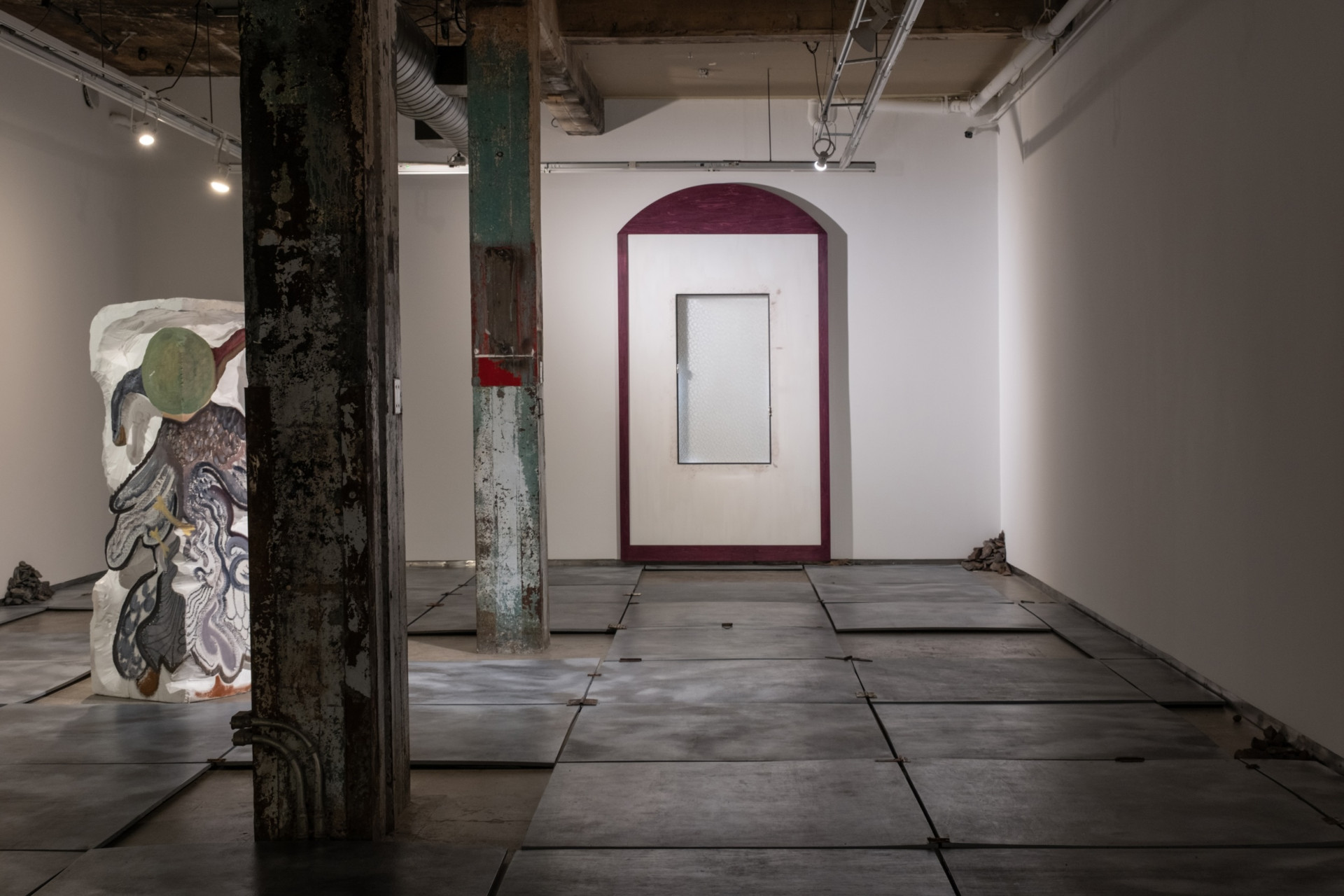
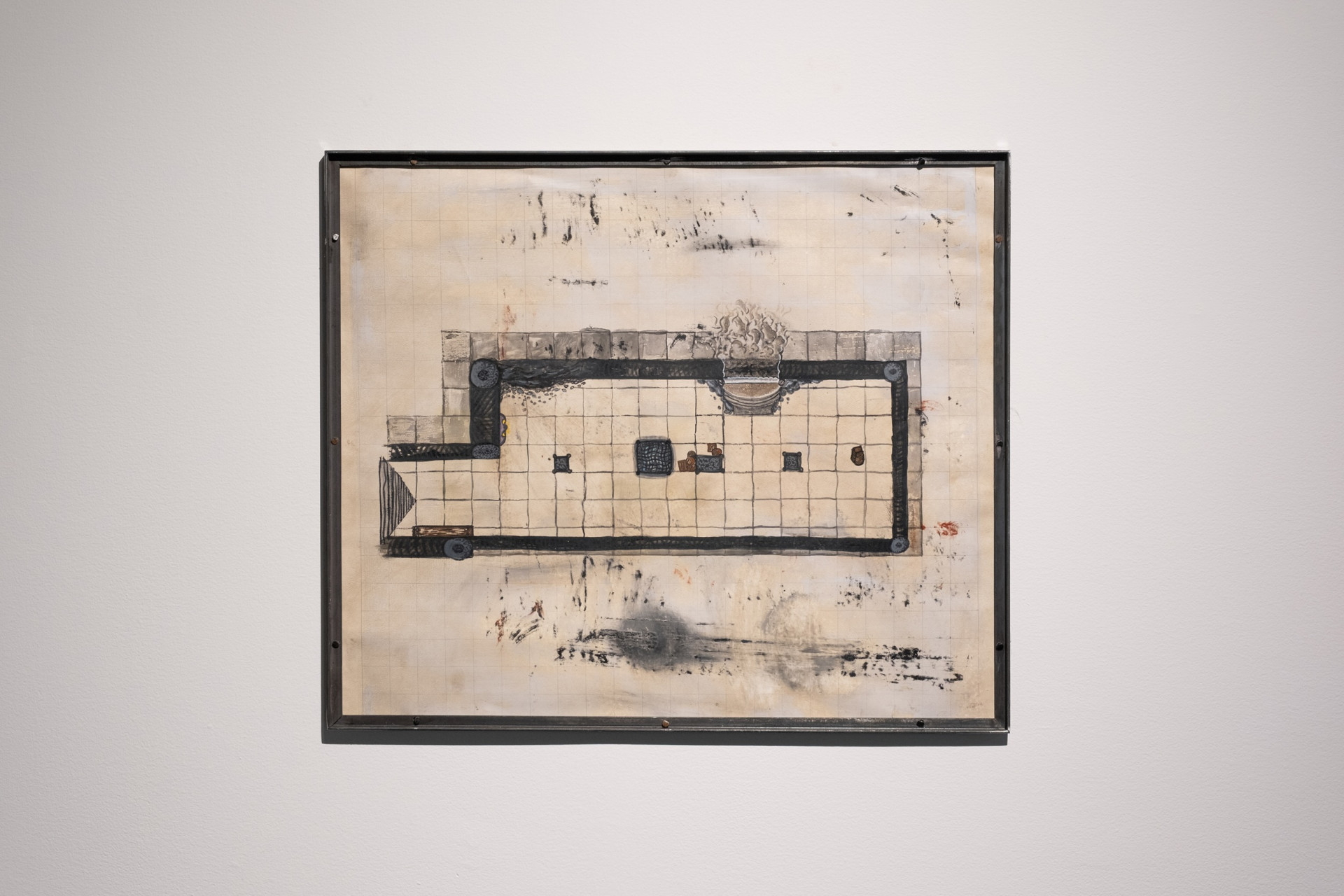
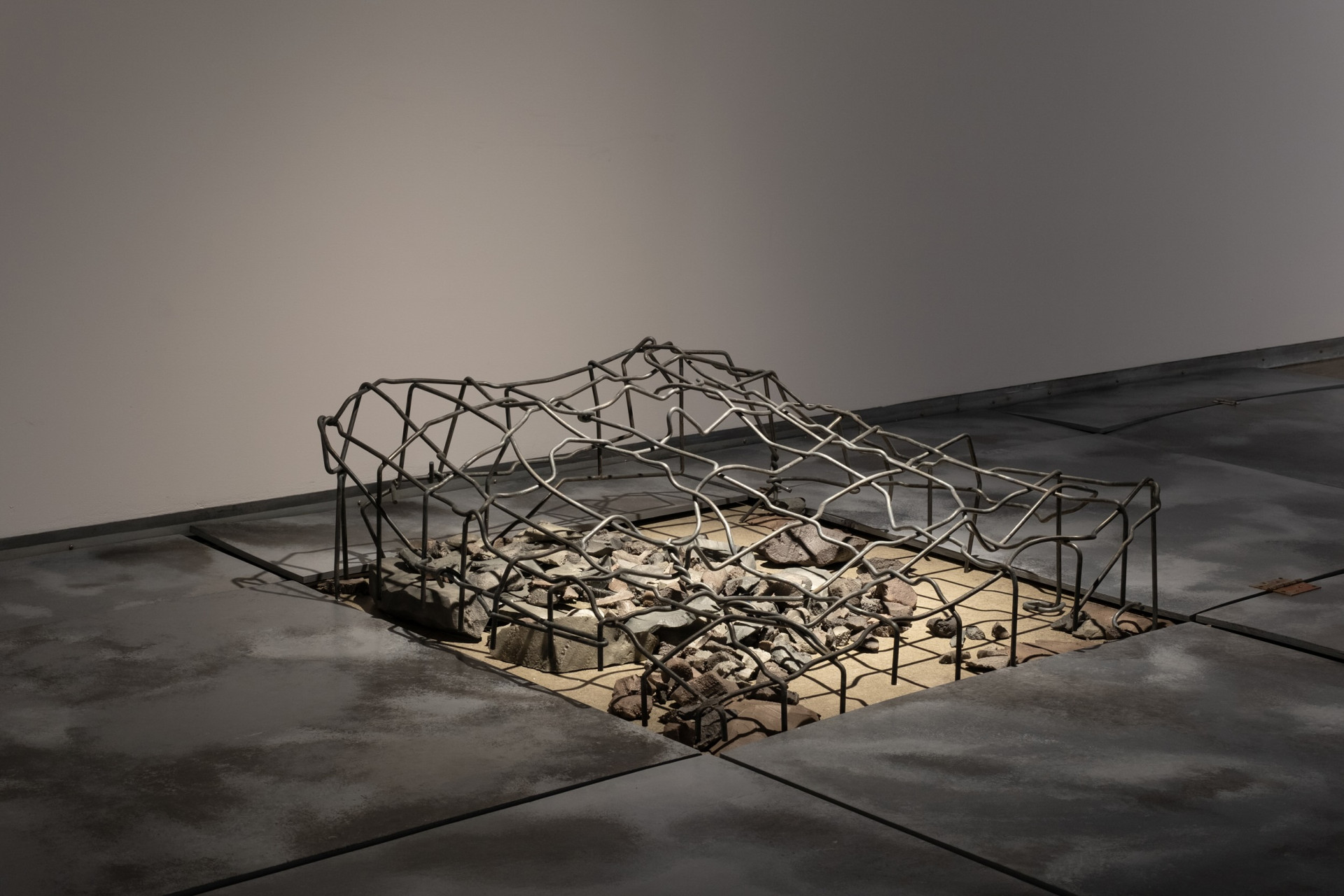
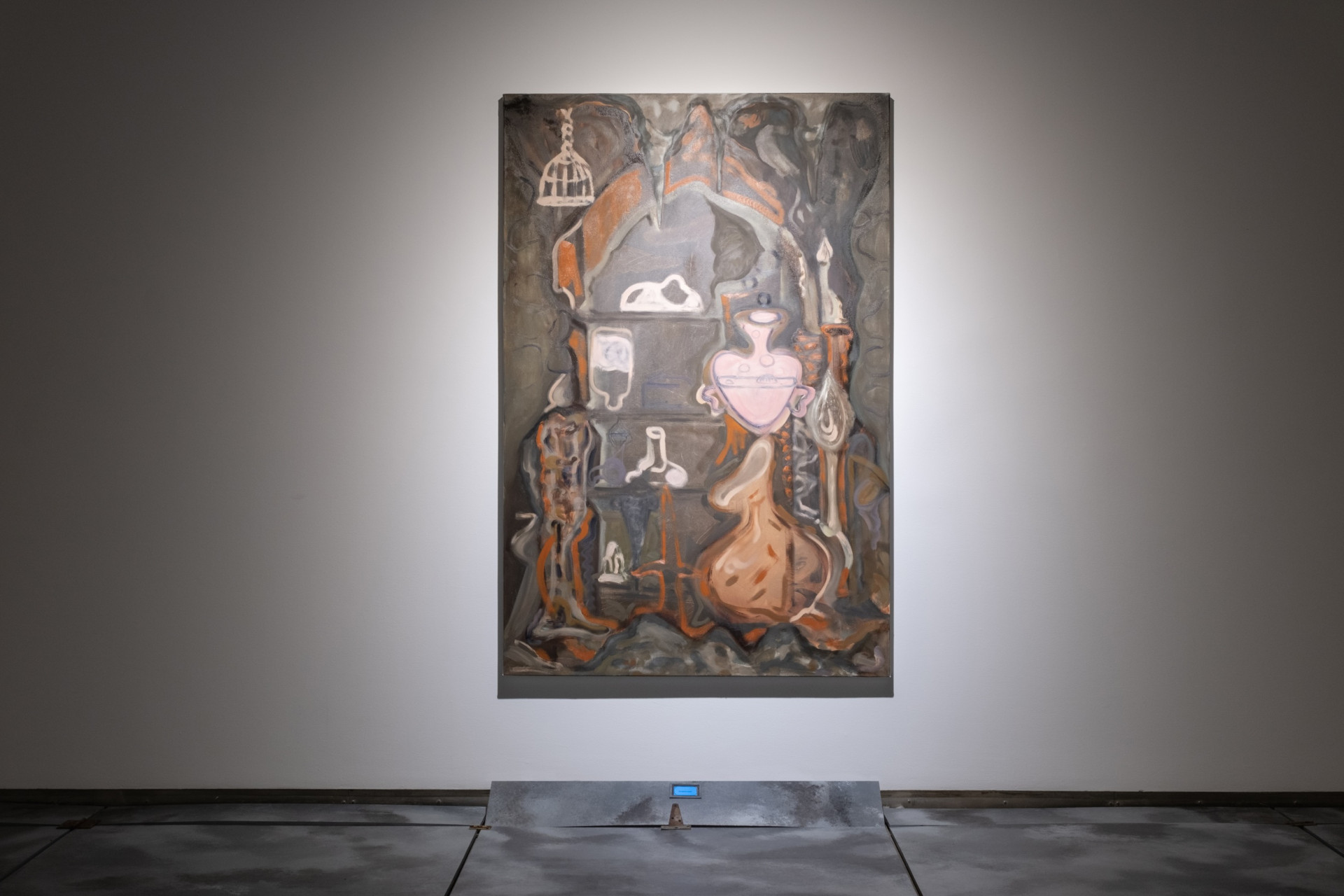
The exhibition Jets de sauvegarde by Mégane Voghell explores play as a strategy for distancing oneself from reality and allowing one to compose with its unstable and sometimes cruel nature. By drawing on a ritualized and enigmatic imagination, Voghell establishes a fictional space with protective powers, just like the “saving throws” evoked in the exhibition’s title, which, in the universe of role-playing games, refer to rolling the dice in order to avert an imminent threat. While a higher number guarantees a better defence, a lower number leaves one vulnerable to danger.
Saving Throw: You throw a twenty-sided dice. It rolls slowly and lands on 11, a mixed result. The defence holds, but only barely. The attack is checked without being entirely neutralized. You move forward, protected, but staying on your guard.
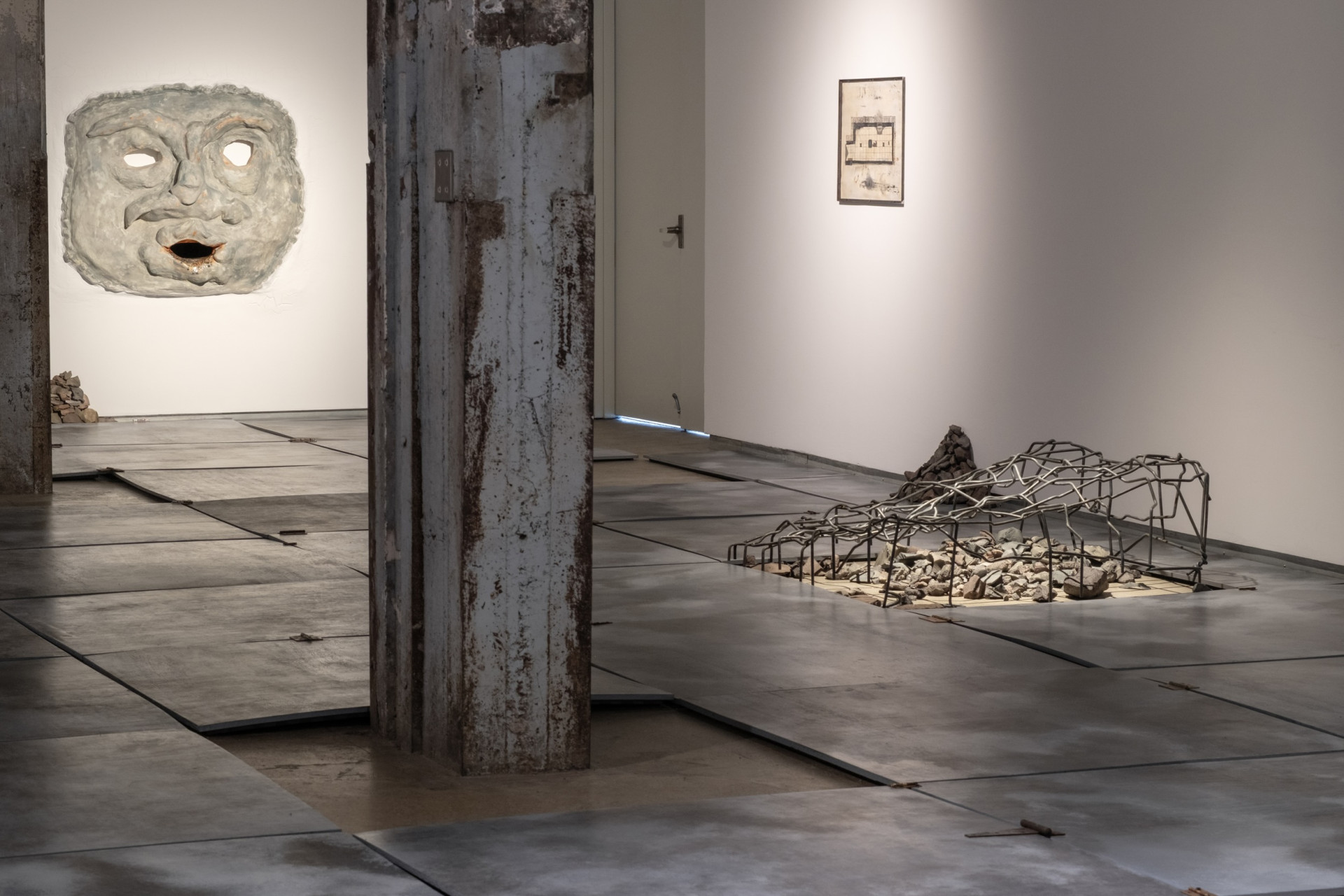
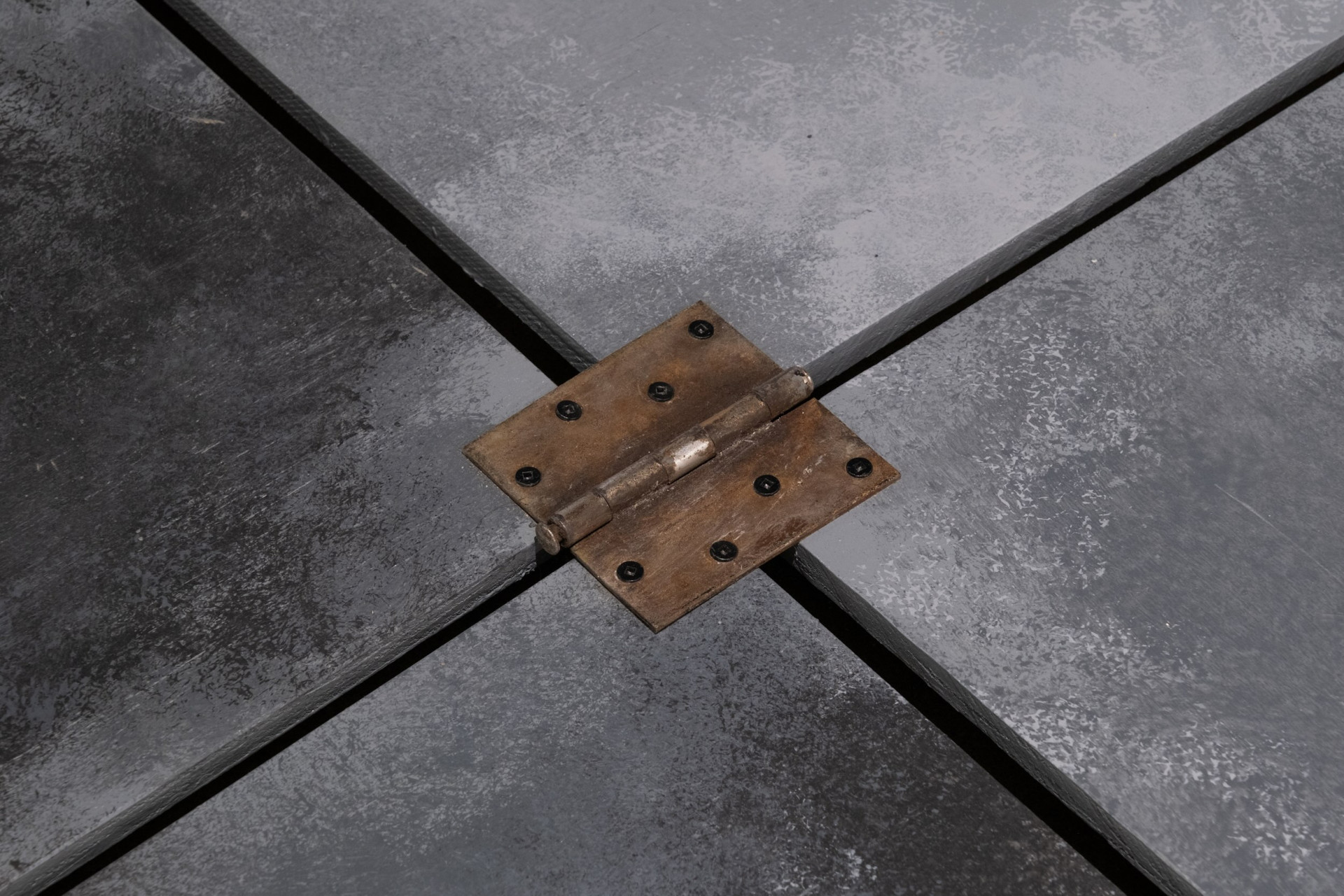
Every one of your steps and observations takes you into a story that is in the process of being written and whose internal logic is revealed as you progress. At the crossroads of speculative fiction and a role-playing game, the space around you forms a hypermedia environment that incorporates graphic, pictorial, sculptural, and video works inspired by the narrative and social mechanisms of the famous game Dungeons & Dragons1. A large installation covering the gallery floor evokes the game board’s grid and serves as a connecting thread between the different works in the exhibition. These appear in sublimated and quasi-abstract forms, like vestiges of a parallel universe: a golem trying to shed its own material, a portal leading to an unspecified afterworld, an inventory of objects undergoing constant metamorphosis, and oubliettes hiding distant memories. Each element seems to belong to a fragmented mythology whose connections only you can re-establish.
Here, imagination functions as a buffer zone reconfiguring threats into surmountable ordeals, converting angst into empowerment. D. W. Winnicott2 sees it as a transitional space where experiences can be felt without having to be completely endured, echoing the theories of Johan Huizinga3 who understands play as a separate space-time in which reality can be paused, ritualized, and replayed. Clément Rosset4 also reminds us that any attempt to double reality by replacing it with a consoling fiction indirectly reveals its irreducible nature. Play does not override reality: it offers a shift, an echo, a variation.
Saving Throw: You roll the dice again. It spins, falters, then lands on a modest 3. The protection wavers. The fears from which you were trying to escape are seeping into the fictional world where you had sought refuge. Terrified, you hear them coming closer step by step.
The game reveals its dual nature: as refuge and ordeal. Imagination displaces fears without ever managing to erase them entirely. The structure offered by the game soothes anxiety by inscribing it into a measurable framework, governed by a set of probabilities. What looks like chaos becomes structure; what threatens to devour allows itself to be contained. In this oscillation between vulnerability and control, Jets de sauvegarde proposes that you consider the imagination not as an escape, but as a way of inhabiting a precarious world by temporarily redrawing its rules.
The forms punctuating the exhibition are concrete projections of internal states each expressing in turn an invisible heaviness, a rush of confidence, a desire to escape, a temporary concern, and even a drive for self-affirmation. By superimposing a fantastical imaginary over the gallery space, Voghell creates a shield against its easily intimidating character and the rigidity of its institutional framework, replacing it with a playful and participatory fiction. However, beneath the surface, shadowy tensions persist and nameless worries loom.
Saving Throw: You roll the dice again, hoping to protect yourself from the darkness closing in around you. You get 18, a resounding success. The threat recedes, splinters, and instantly dissipates. A break opens up. You can breathe again. The world, though still fragile, is holding up despite everything.
In this bright, momentary interval, you can perceive somewhat more clearly the fragile coherence of this world. What first appear as disparate works prove to be linked by a network of subterranean connections forming an organic storyline. Their singularity is linked by a collective memory, as though each fragment held traces of the other fragments in it. In the twilight, the golem keeps watch, the portal vibrates with an unsteady light, and enchanted objects seem to be waiting to be activated. Shrouded in mystery, a world unfolds before you with its creatures, its thresholds, and its silent quests that appeal to your sense of adventure.
As you move further in, the game promises neither definitive victory nor absolute defeat, but rather a series of attempts, uncertain gestures, replays. The dice keeps rolling, suspended between different futures. And in this very movement, something persists: the ever-renewed possibility of transforming fear into story and fragility into a terrain for invention.
Renaud Gadoury
Translated by Oana Avasilichioaei
1This first medieval-fantasy, tabletop role-playing game was created in 1974.
2D. W. Winnicott, Playing and Reality, 1971.
3Johan Huizinga, Homo Ludens: A Study of the Play-Element in Culture, 1949.
4Clément Rosset, The Real and Its Double, 1976.
Curator
Renaud Gadoury