

In a famous 1975 essay, Pier Paolo Pasolini laments the sudden disappearance of the fireflies from the Italian countryside due to increased air pollution and pesticide use. For him, this loss becomes a metaphor for the disappearance of the pre-war agrarian and proletarian world and its ritual gestures, swept aside by the cultural homogenization that came along with the rise of consumerism. This disintegration of the sacred as a result of a productivity-oriented mindset is consistent with the disenchantment of the world described by the philosopher and sociologist Max Weber, which also refers to the tragic loss of meaning and mystery resulting from an escalating rationalization of reality.
In his book Survival of the Fireflies (2009), the philosopher and art historian Georges Didi-Huberman revisits Pasolini’s essay thirty-four years later in order to challenge its pessimism. Objecting to the idea of certain extinction, he suggests that fireflies have not disappeared but remain visible to those whose eyes have gotten accustomed to the ambient darkness. He asks us to pay attention to the faint and wavering glimmers that keep part of the invisible and the sacred alive, at the margins of power.
The exhibition A Light That Never Goes Out is dedicated precisely to these narrow spaces that keep glowing in the gloom. It pays homage to the light that nourishes hopes of healing and watches over parties in the dead of night, re-establishing connections and teaching us how to no longer be alone together, like in those fleeting, radiant moments that allow us to glimpse a beyond and hold the promise of a shared transcendence.
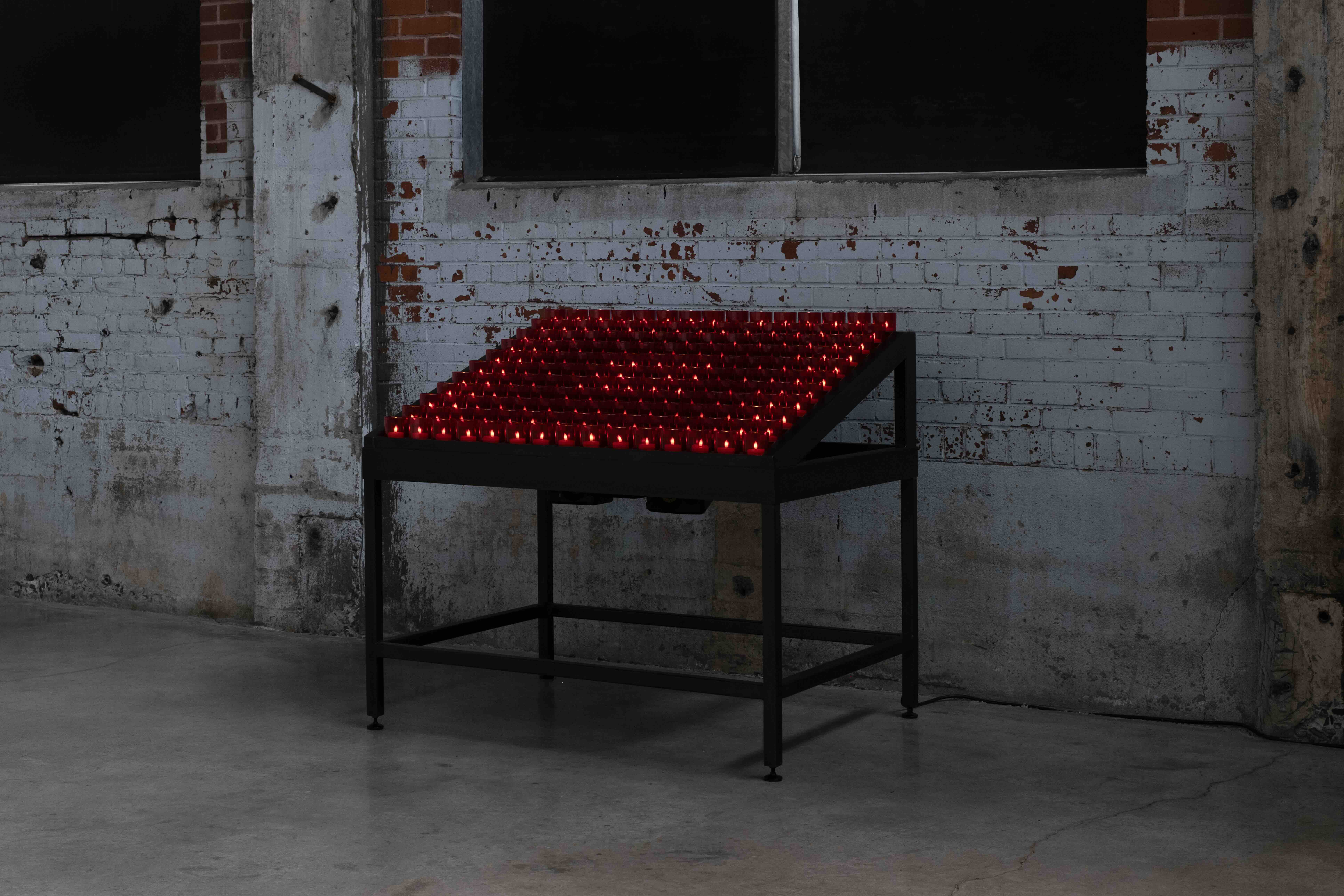
The exhibition opens with a work by Jeremy Shaw, a constellation of votive candles that flicker hypnotically, creating a hallucinatory filter for dreams and meditative wanders. Although detached from their liturgical framework, the flames retain their symbolic density: they summon the invisible sedimentation of prayer, mourning, and vows taken by candlelight, over which their flickering glow keeps watch. This entry into the subject matter sets the tone of an encounter in which the sacred keeps fluctuating and reinventing new forms.
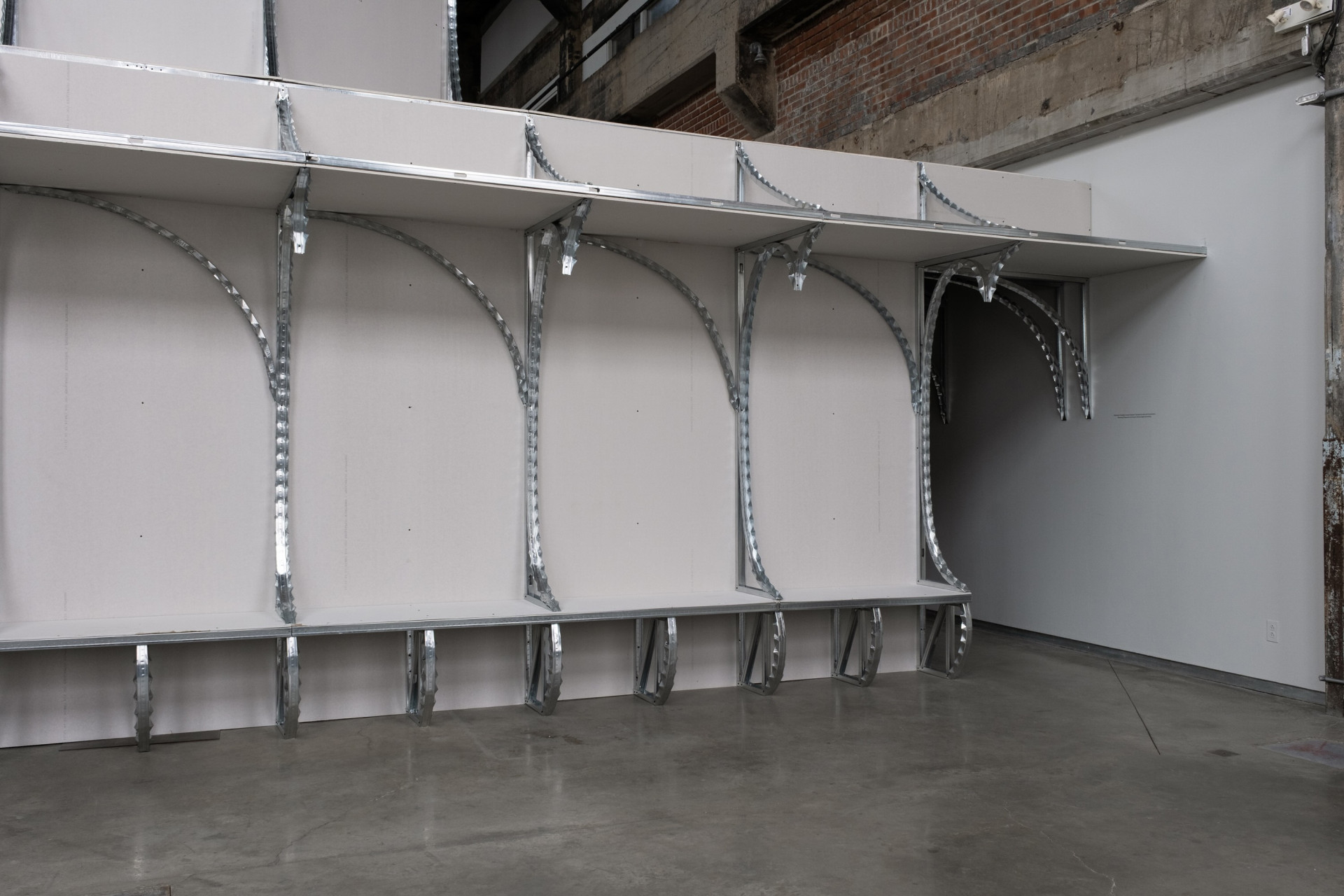
A few steps away stands the architectural installation Trinity (North Walk) by Simon Petepiece, a monumental structure that acts as a threshold and turns movement into a ceremonial experience. Inspired by the architecture of medieval cloisters, which ritualize the passage between worldly and spiritual life, the work uses the most ordinary materials: drywall panels, metal studs, and industrial screws. Reduced to the essentials, the installation converts the poverty of these materials into a form of meditative austerity. This sparseness resonates with a long theological tradition, which views asceticism as a way of reaching the divine.
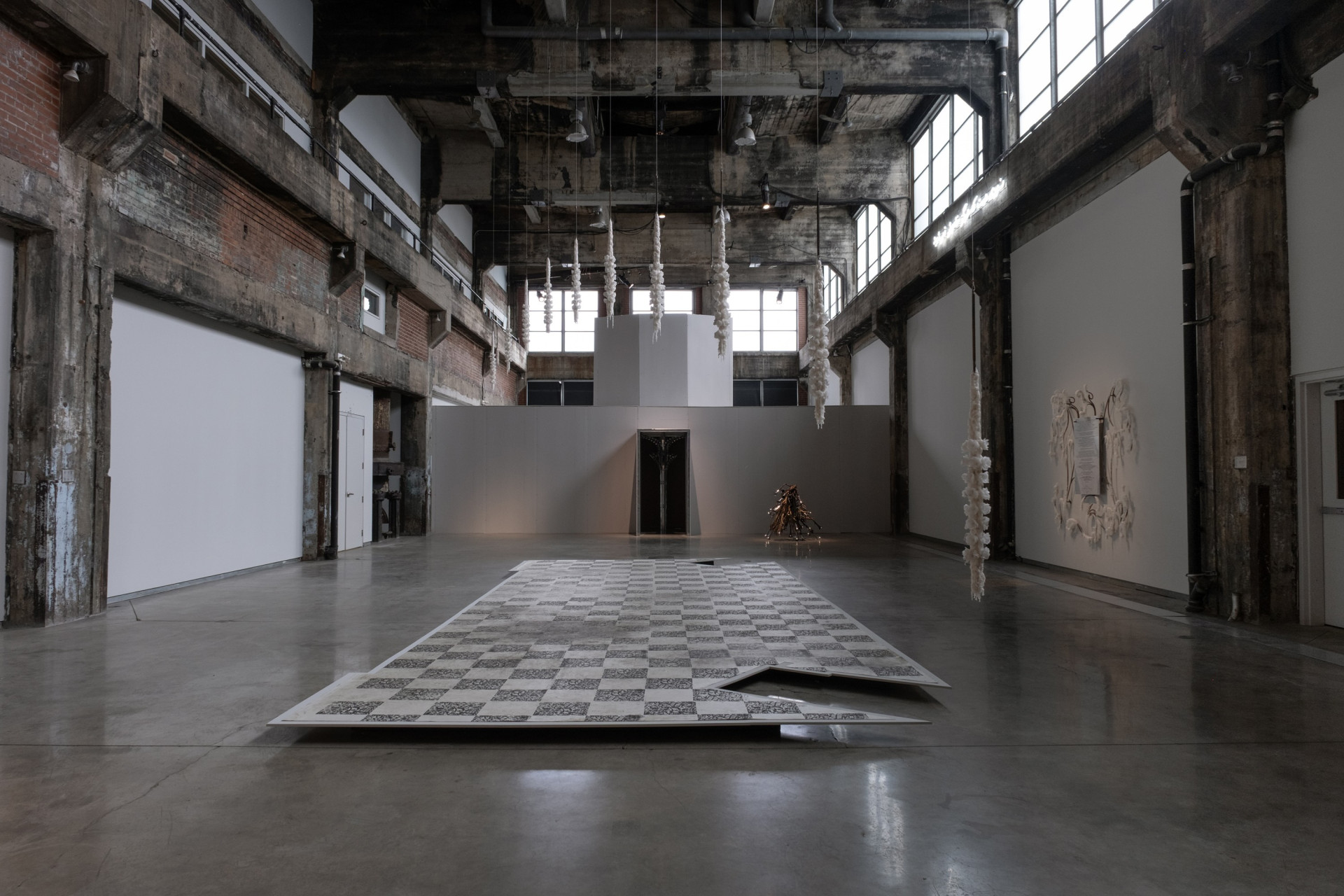
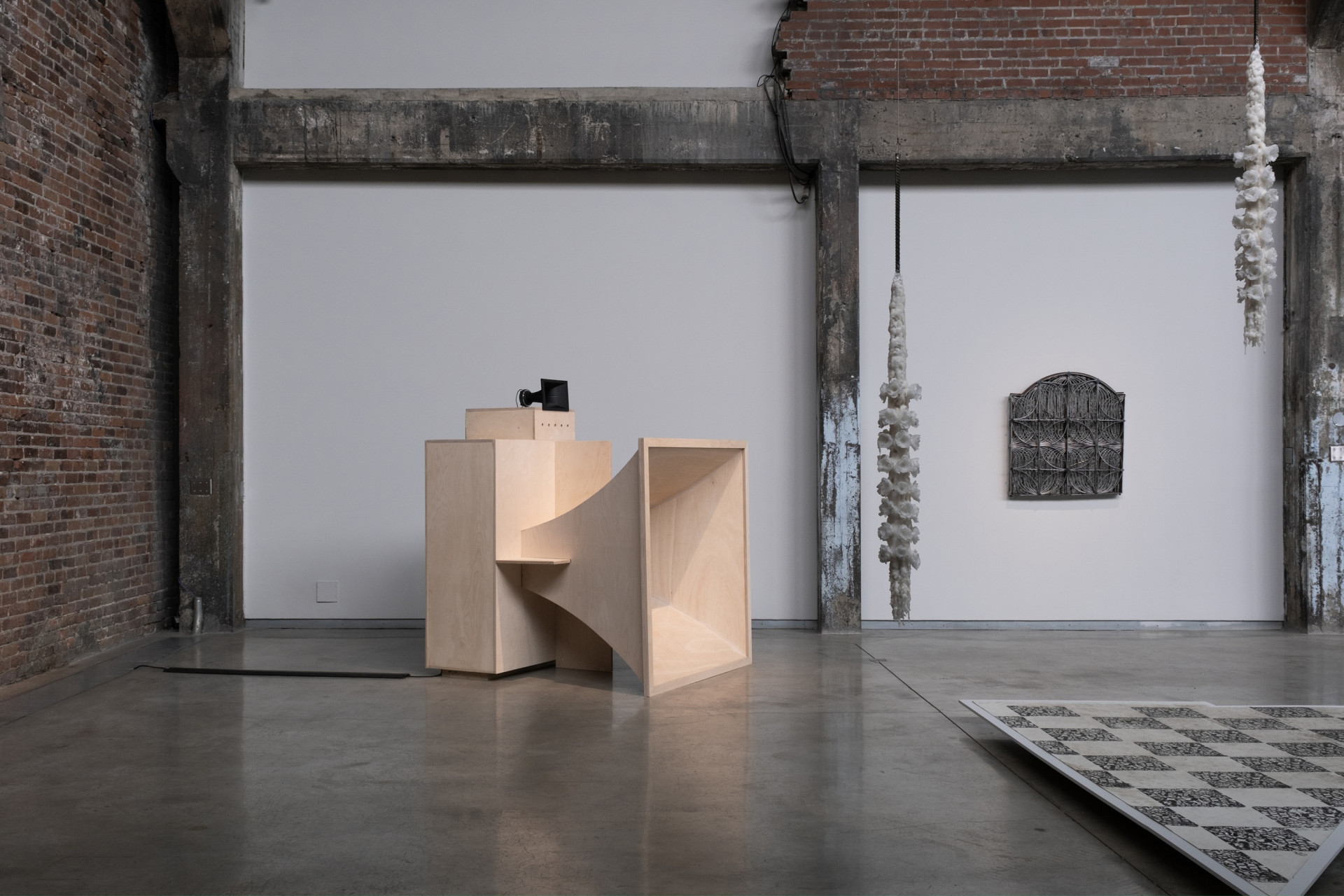
Petepiece’s installation leads to the fragment of a dancefloor from a New York nightclub that the artist Jesús Hilario-Reyes has transposed into the context of the exhibition. Scattered and disordered traces cover the checkerboard pattern of the floor. Created by dancing feet, these marks translate the chaotic and unruly mass of bodies. The dancefloor becomes one of the rare contemporary spaces in which a shared transcendental experience is still possible: no longer before the altar but in the communal, pulsing beat, when the night temporarily renders us porous to one another.
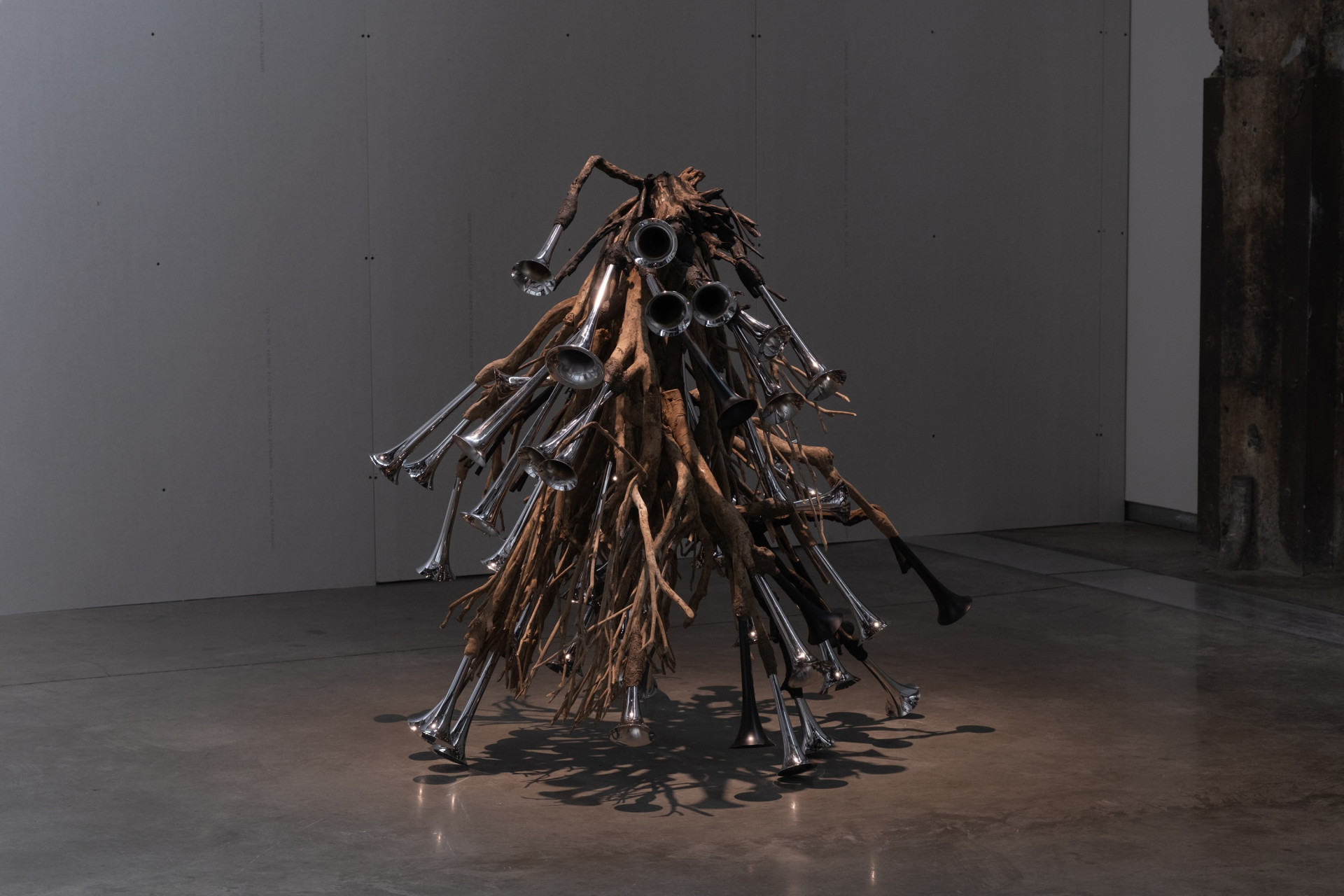
In response to this vestige is Salt Tolerance, a sculpture by Hilario-Reyes that takes the form of a sound system filled with tangled mangrove roots, a symbol of a rhizomatic and open identity. It plays a techno composition created from the piercing song of the osprey, a bird whose high-pitched calls announce hurricanes, and geophonic data of the seismic activity generated by a rave. A celestial breath and an earthly beat, the storm and the party convey, each in their own way, the intensity of vibrations that pass through bodies and bring them together.
Hanging above this soundscape, the installation Naab Omar Castillo Alfaro features a series of stalactites composed of paraffin flowers. In the Mayan language and culture, naab refers to the white water lily, a symbol of the connection between the terrestrial and aquatic worlds. The organic form of the stalactite evokes the cenotes, natural, sacred sinkholes in which waterlilies thrive and that the Maya considered as thresholds to the underworld Xibalba. Suspended above the traces of dancing bodies, the installation superimposes two kinds of transcendence, one horizontal and collective, the other vertical and cosmological.
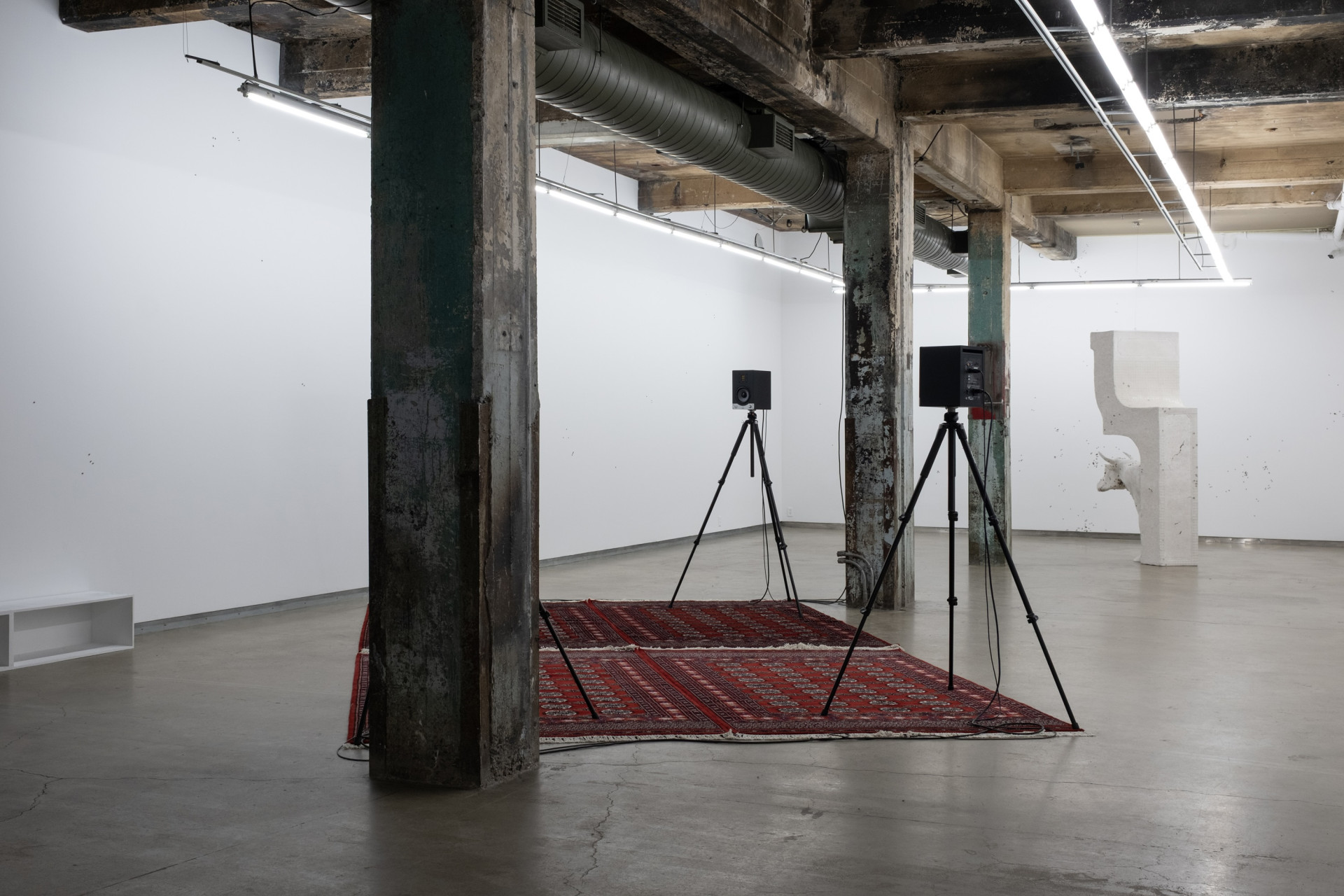
In the adjacent Small Gallery, the work Al Madat by James Webb plays the recording of a dhikr, a Sufi chant recited by patients at the Sultan Bahu Rehab Centre, located in Cape Town, South Africa. Brought to the Cape by the enslaved Malay peoples during the colonial era, the dhikr (which means “remembrance” in Arabic) is a ritualistic practice of reciting divine names, the vocal and breathing techniques of which can induce a trance-like state. Converted into a therapeutic tool, this practice supports patients in their recovery from addiction. On the floor, Webb has placed a series of Karachi rugs, on which visitors are invited to sit or stand shoeless to experience the rhythmic voices and join, in quiet contemplation, a community of breath woven between absent and present bodies.
In the same gallery, the work Infinite Yearning met with a finite world vibrates to the rhythm of the heartbeats of a woman and her unborn child, the pulsations of which go in and out of sync. We are encouraged to take the speaker and place it against our chests in order to become part of this intimate fusion. The communion between mother and child shows birth—and with it the emergence of individuality—as a deeply relational process, blurring the boundaries between self and the other.
The surrounding space is populated by thousands of bees that the artist Camille Charbonneau made by hand. According to Mormon tradition, from which they had to step away to live their queerness, the bee embodies unity in faith. Separated from the hive and freed from its moorings, the bee becomes open to new interpretations, hence the installation’s title of Unmoored. At the back of the space, a sculpture reproduces a fragment of a baptismal font, a central element of Mormon temples. Near and remote at the same time, these symbols draw their strangeness from a dual relationship: familiar enough to recognize, but too distant to reach, like an old acquaintance whom we think we recognize from afar without being sure.
An intuition underlies the entire exhibition: the sacred is always present, distributed in new and sometimes unexpected forms. It attests to the diverse rituals that bring us together and show us glimpses of the beyond. The fireflies continue to glimmer for those who have learned how to see them. It is sometimes difficult to see the light in a world that seems to be getting darker under the cumulative effect of identity retrenchment, climate disruption, and an extractive economy bent on conquering all that still resist it. Flame, altar, breath, temple, or swarm: the works in the exhibition represent multiform lights whose brilliance marks the night, not to dissipate its darkness but to teach us how to see through it.
Renaud Gadoury
Translated by Oana Avasilichioaei
With the generous support of the Rennie Collection, delivery of James Webb’s Al Madat is guaranteed.
Curator
Renaud Gadoury