

Solar Lamentation
West Texas. The plain extends to the horizon, blanched by the sun. A gas flare burns, rising above some extraction facilities, while a figure walks in the gravelly sand, head down, attentive to the ground. She bends down, picks up a stone, weighs it in her hand, then slides it into a plastic jug she’s holding.
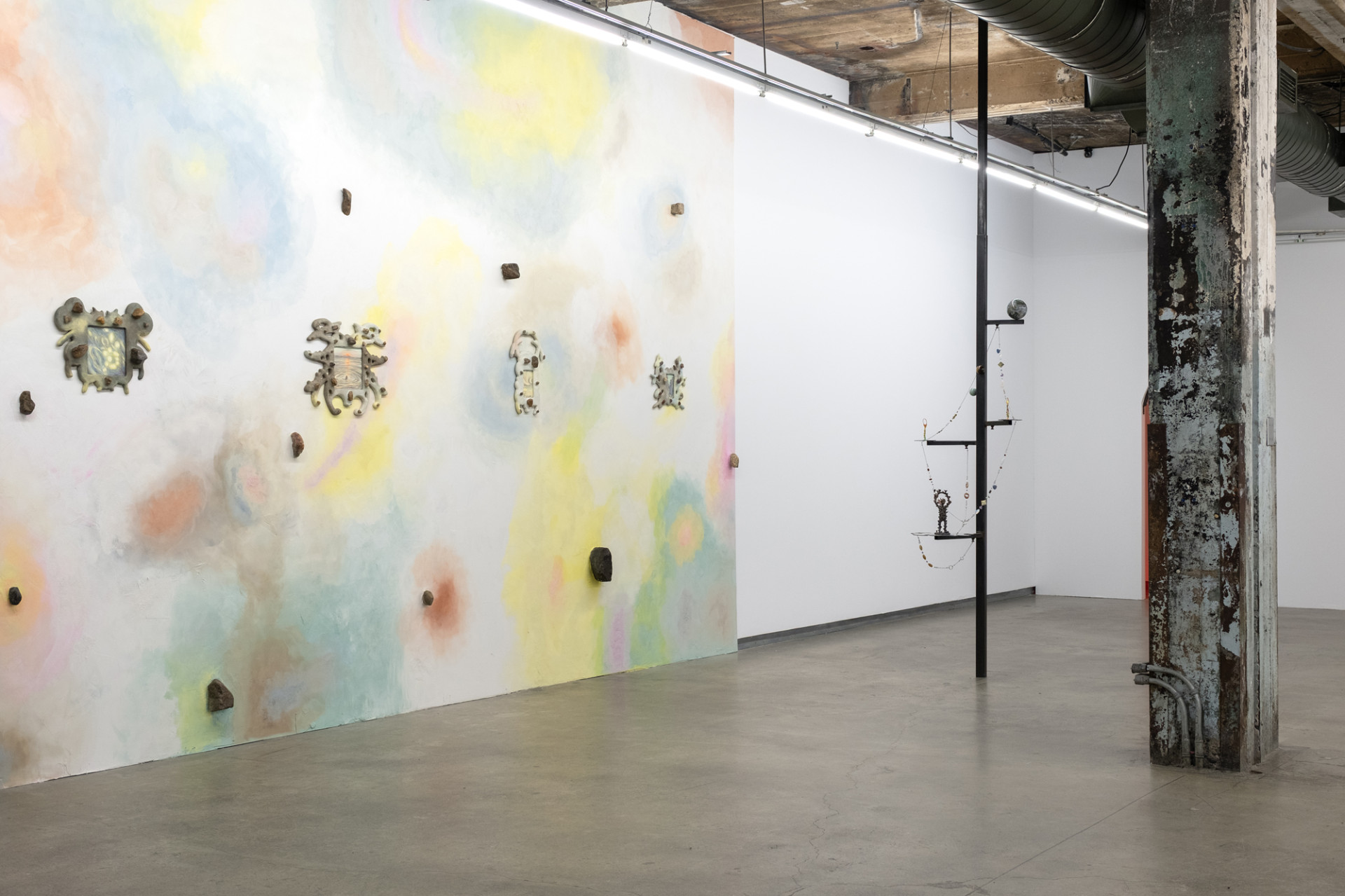
Solar Lamentation develops from this careful attention to the traces of time. For several years, Shanie Tomassini has wandered through terrains marked by light and erosion, from the American deserts to the shores of Laurentian lakes, in order to bring back gleaned fragments: stones, sand, light, or simple memories. These relics become the raw materials of an open and resolutely personal mythology, which the exhibition presents like a story with a changing sky. Under the guardianship of the sun, Solar Lamentation follows its cyclical rhythm, which shifts from the vibrant brightness of morning to the incandescence of sunset. At once benevolent deity and backdrop to our lamentations, the sun traverses the entire exhibition. A primordial life source, it reminds us, nonetheless, of its inevitable nightly decline.
A lake at dawn. The water’s surface catches the first glimmers of daylight, replicating them into orangey shimmers. As a swimmer dives in, the concentric ripples formed by her passage slowly grow larger around her, as though the water is redirecting the light, from circle to circle, all the way to the shore.
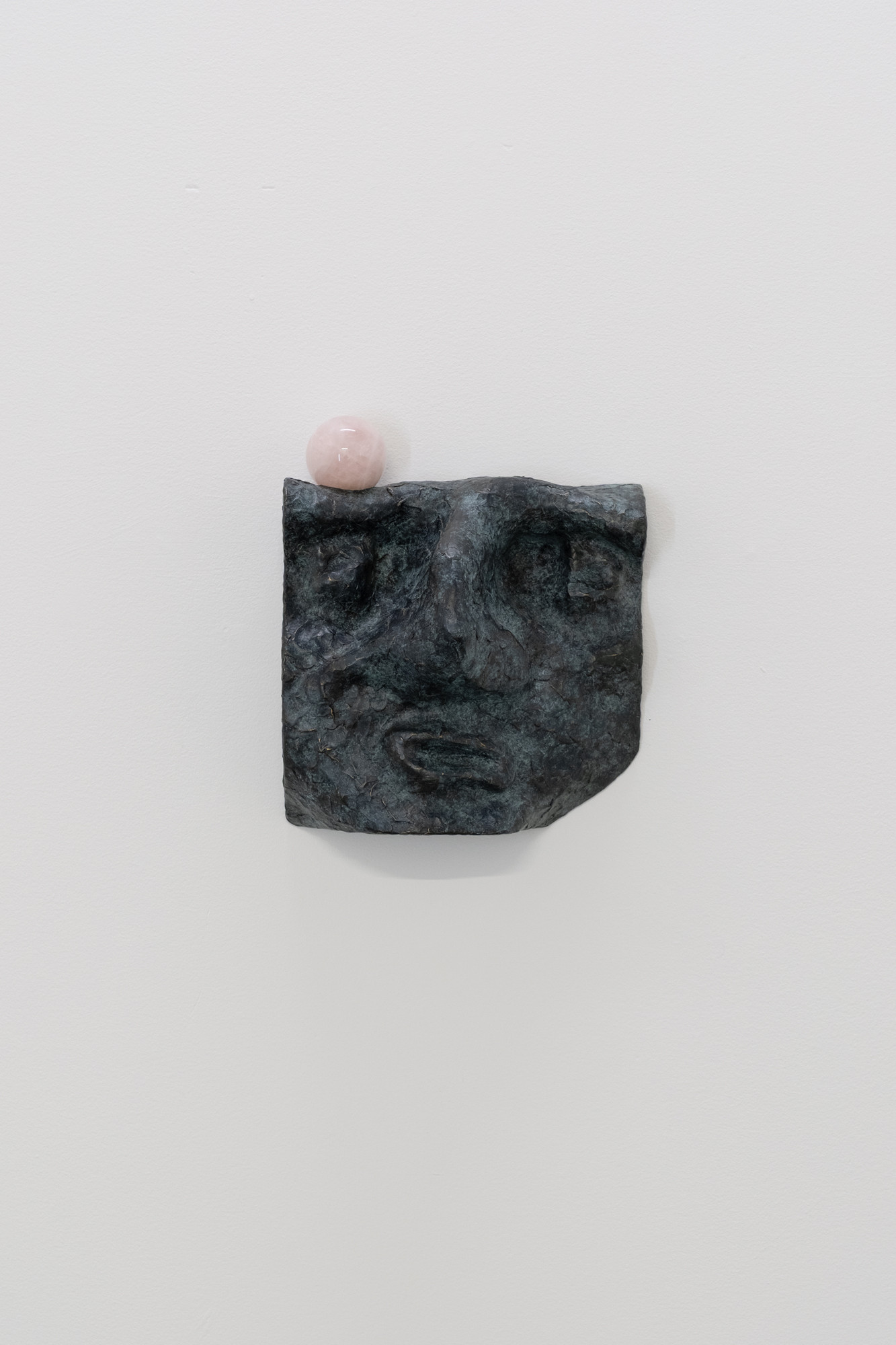
At the entrance of the exhibition, a bronze head keeps watch from its alcove. Made from a sculpture in the round that was scanned and enlarged, it wears a sphere of pink quartz, like a mineral thought or a dormant second sun. Its impassive face looks on as if to warn us: we are entering a space where materials can see.
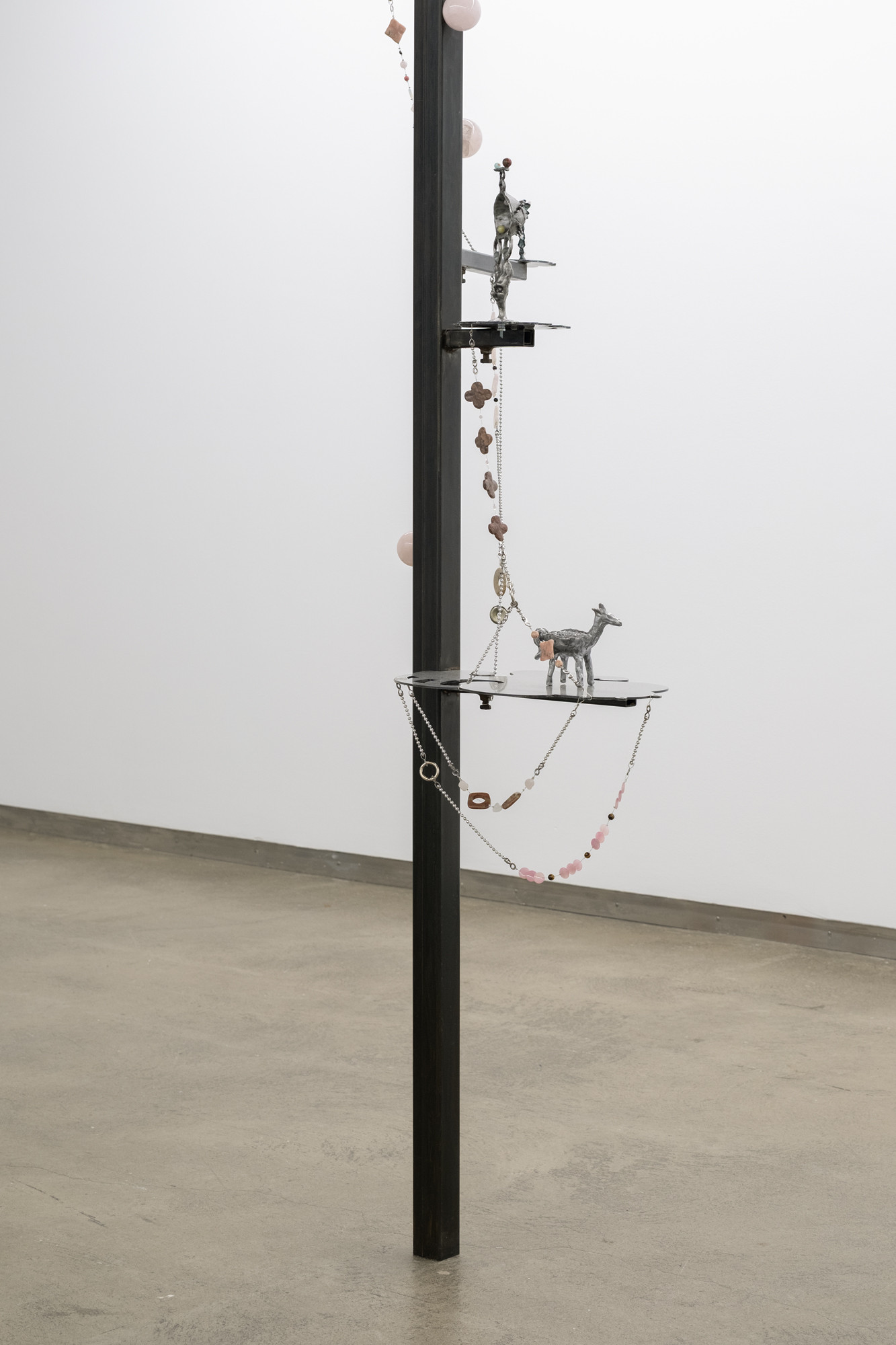
In the gallery bathed in white light, a series of metal structures stand throughout the space. Their frames hold miniature bronze and aluminium figures, derived from a casting process in which the original piece is first burned and sacrificed before the final object can emerge. The casting re-enacts at an accelerated pace what the sun does to landscapes: a slow combustion that transforms everything it touches.
Facing these Lilliputian beings is the guardian figure of the exhibition: a monumental anthropomorphic sculpture with a skin of cement. The work is based on a small, handmade, clay statuette whose enlarged shape it retains. Tomassini’s initial manual gesture is transposed to a geological scale, turning the sculpture into a larger-than-life megalith. Between this colossal guardian and the bronze figurines around it, a dialogue unfolds across different orders of scale, in which the intimate and the immense reflect one another.
An abandoned mine somewhere. The galleries are silent and the slag heaps are rounded by erosion. What industry extracted from the earth has left behind holes that only the light can reach at set times. In these landscapes torn from themselves, Tomassini draws. She traces reflections, notes glints of light, maps shimmers.
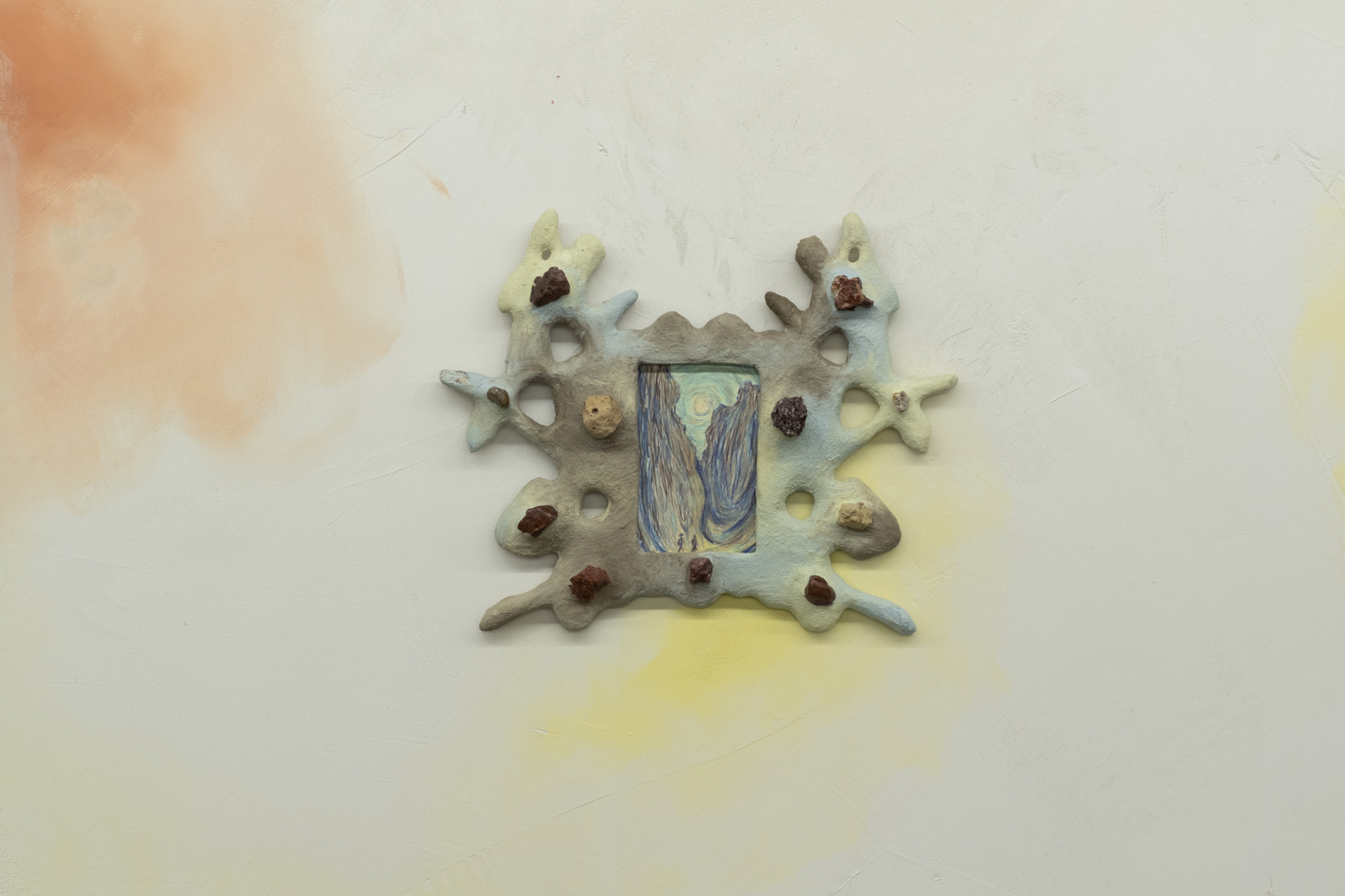
The drawings presented in the exhibition come from sessions of meditative observation. Drawn with colour pencils, they capture the sun’s reflections on water, dunes, and rocks. The pencil imposes slowness and demands that we accept to see light move even as we set it down on paper. Each drawing records a duration rather than a flash. The colours respond to what remains rather than to what is observed, so that what settles on the paper is not the landscape but the mental space that holds a memory of it.
The drawings are mounted in symmetrical frames reminiscent of Rorschach inkblots, which offer a projection surface for the mind. Stones collected in the landscapes represented in the drawings are set into the frames. The proximity between the materiality of the place and its representation transforms the drawings into portable altars, able to retain the spirit of a terrain and transpose it somewhere else.
Assembled on the wall, they form a constellation of moments connected by the light that has passed through them and the hand that has gathered them. In them, we implicitly read the intuition prevalent in the exhibition: we can only see the world in fragments, and each fragment contains the whole world.
Sunset. The white light fades, the air thickens with orange. It is the hour when edges soften and lamentations begin. The scarlet hue of the setting sun pours its lament below the horizon as though singing its loss in order to traverse it more easily.
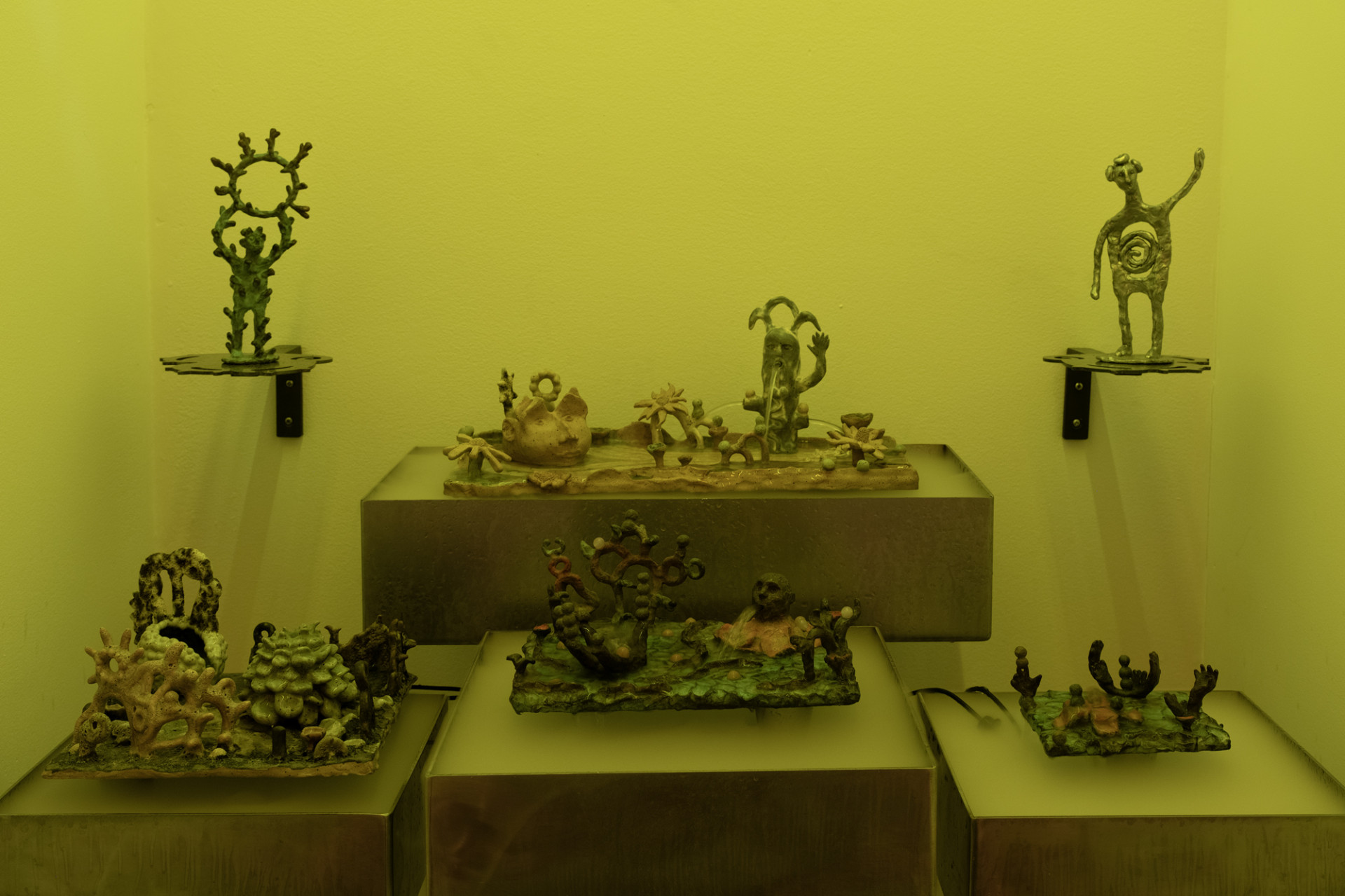
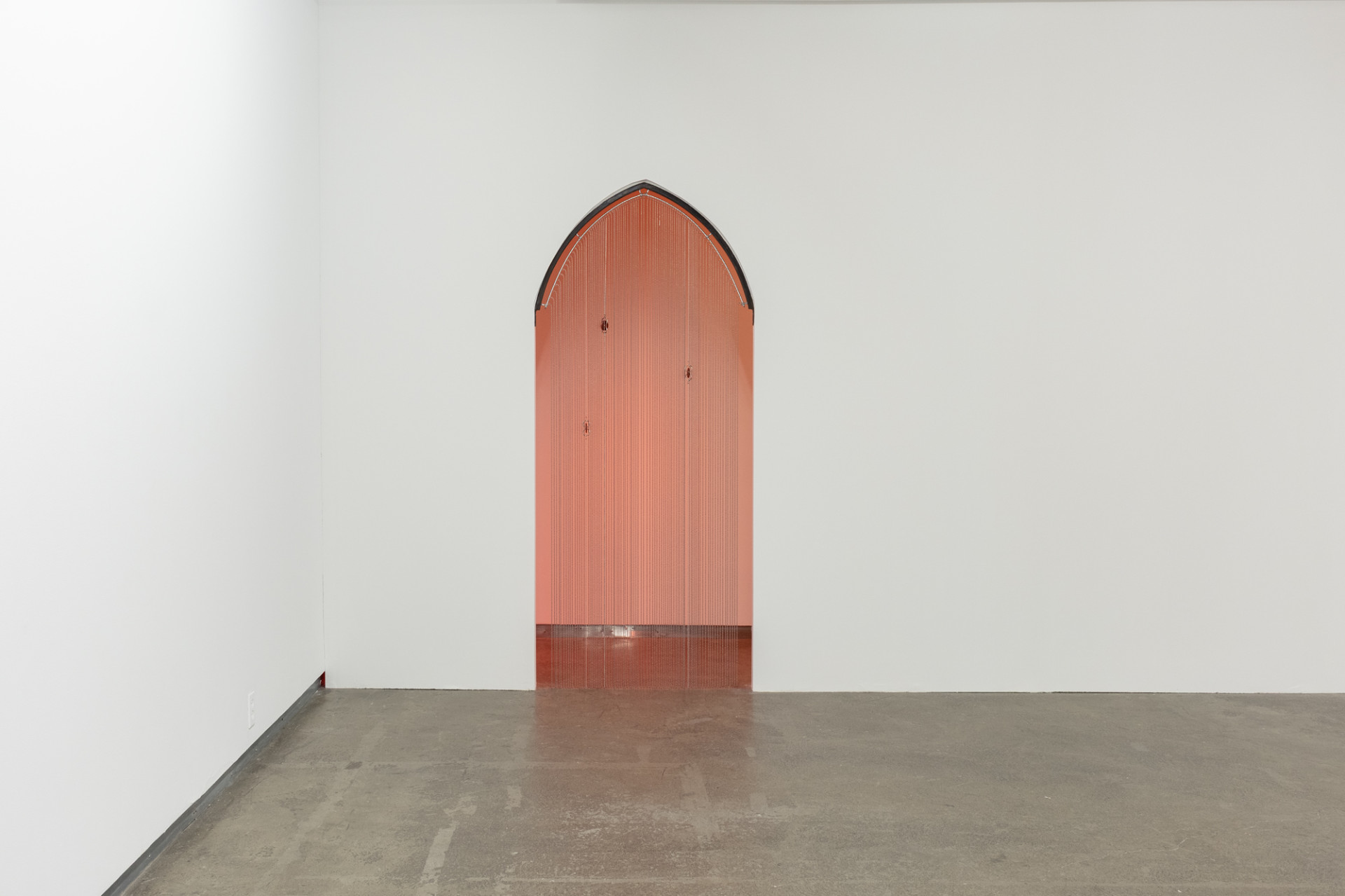
At the back of the space, a wall is pierced by an opening screened by a curtain of metal pearls shining with a warm and incandescent tint. This luminous presence acts as a symbolic and sensorial passage, leading us from the rational brightness of the gallery to a more intimate solar realm, where light fills the space, concealing as much as revealing. At the end of a narrow corridor, a fountain awaits. It presents surrealist landscapes in bronze patina and enameled stoneware populated by faces, mineral flowers, coral, and other creatures. The water spouting from the mouths of the characters flows in continuous streams, falls and starts again. A true microcosm in which the mineral seems to breathe, the fountain endlessly replays the cycle of water and time. What flows returns over and over again.
Solar Lamentation opens up a timeless space, populated by mystical beings that oscillate between the organic and the mineral, the ephemeral and the immemorial. Attentive to ever changing materials, Tomassini assembles a constellation of moments and places, in which each work is an offering to the passage of time. In the face of the chronic eco-anxiety of our era, the exhibition offers neither consolation nor catastrophe but a patient and ritualistic attention to the slow alchemy of things and the cycles of life. The sun will set on the works just like on the landscapes that inspired them. And it will rise again. Between the start and end of each cycle stands what we choose to collect and recollect.
Renaud Gadoury
Translation by Oana Avasilichioaei and funded by the Government of Canada

Shanie Tomassini
Shanie Tomassini has exhibited her work in Canada, the United States, and Europe, including at the PHI Foundation, the Clark Center in Montreal, Tenerife Espacio de las Artes in Spain, the Arsenal in New York, and the UMLAUF Museum in Austin. She is a recipient of the Fonderie Darling’s Ateliers Montréalais 2023–2026 residency and holds a master’s degree in sculpture from the University of Texas at Austin and a bachelor’s degree in visual arts from UQAM.